Case study · Web app prototype · Personal data
StellarSelf: one profile from a birth date, across astrology, Human Design and five other systems.
A 2025 prototype we designed and built: a four-step chart setup, a calculation service for each system, a library of written interpretations, and XP, levels and daily challenges for learning the vocabulary.
- Client
- Wiserwires R&D
- Service
- Web app · data services · AI
- Timeline
- 2025, archived prototype
- Stack
- Next.js · Express · Python · Postgres · Docker
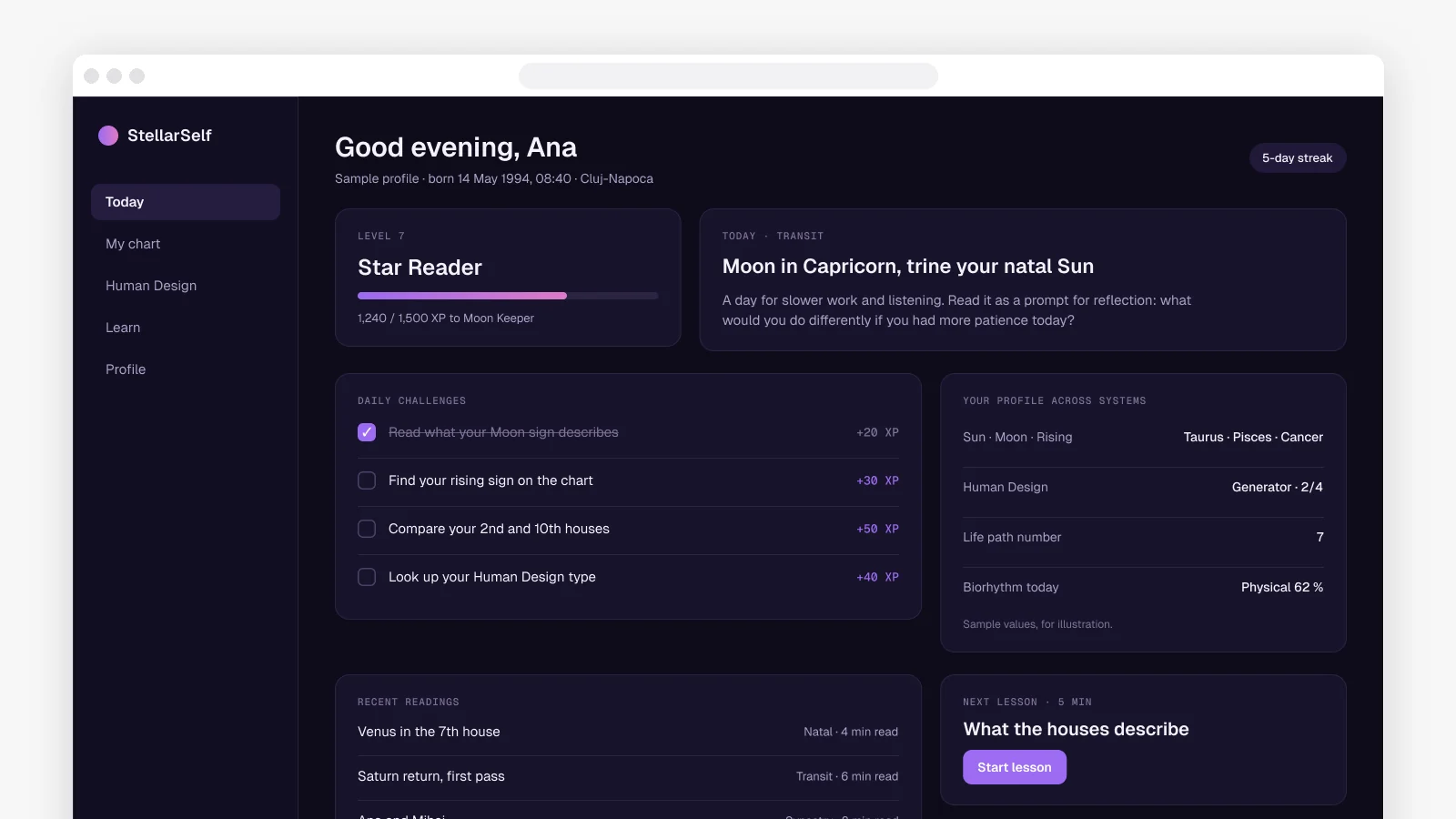
01
Why we built it
People who use astrology and related systems as a tool for reflection often juggle several apps: one for the birth chart, another for Human Design, a third for numerology. Each asks for the same birth data and explains it in its own vocabulary.
We wanted to test whether one profile could hold all of them: enter the birth data once, get the positions right, read plain-language texts a newcomer can follow, and have a reason to come back and learn a little each day.
The hard part is not the screens. A birth time and place have to become an exact moment in history, including old time-zone and daylight-saving rules, before any calculation is right. Our own test set included births in 1970s Romania, where those rules changed.
02
What we built
-
Chart setup
A four-step form: name, date, time, place. Place search returns coordinates; the historical time zone and daylight-saving offset are resolved before calculating, and an unknown birth time is handled as its own case.
-
Calculation services
Each system runs as its own Python service in Docker: planet positions and houses from the Swiss Ephemeris, Human Design, numerology, biorhythm, the Enneagram, tarot and the I Ching. The web app reaches them through one API.
-
Interpretation library
Texts are stored per placement, transit and pairing in Postgres, so they can be reviewed and edited instead of being generated on every visit. A language-model step writes one summary across systems.
-
Progress and learning
XP, levels with titles, achievements and daily challenges, modelled on language-learning apps, so the vocabulary sticks a little at a time.
-
Testing
Playwright suites for the chart flow, accessibility, mobile and the API, plus scripts that compare calculated positions with reference values.
Screens · Architecture
-
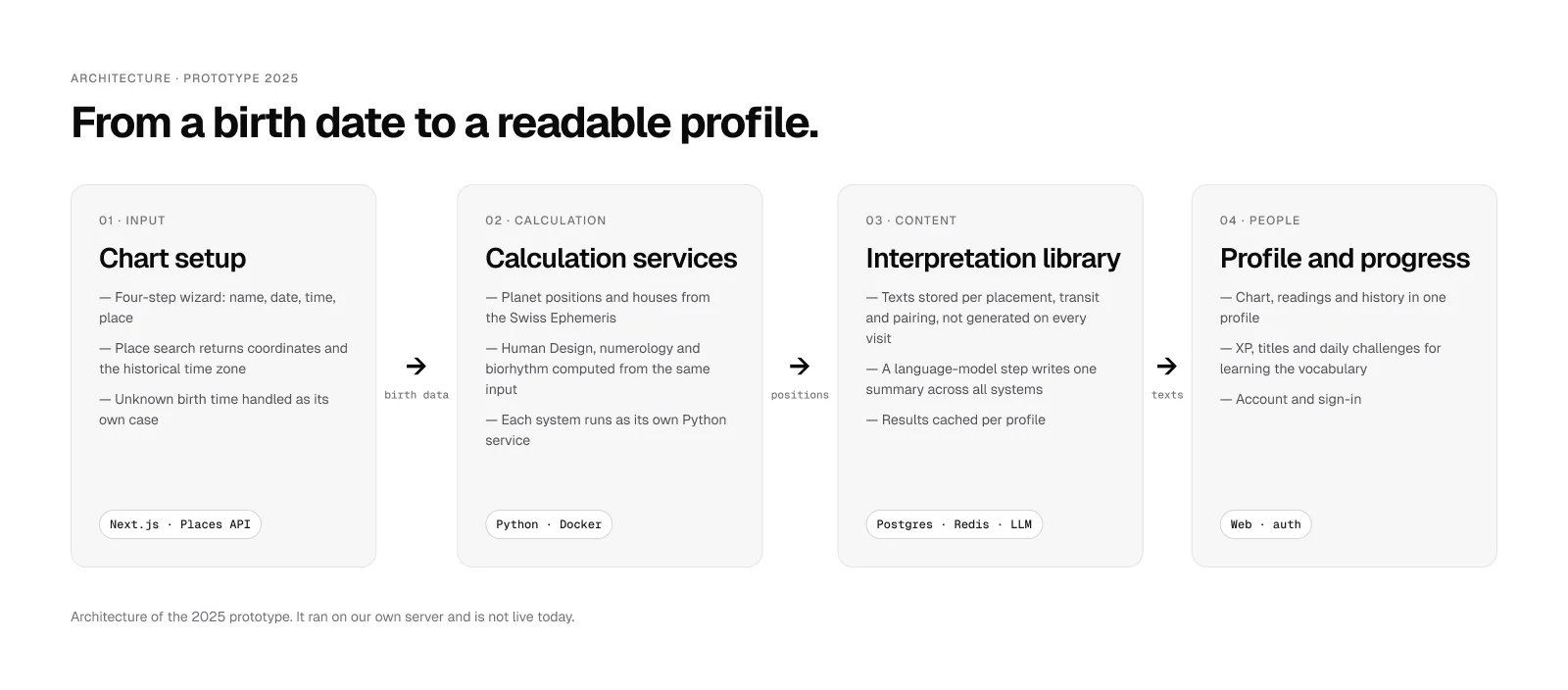
Four layers, from the birth data to a readable profile.
Screens · Redesigned screens
Redesign-
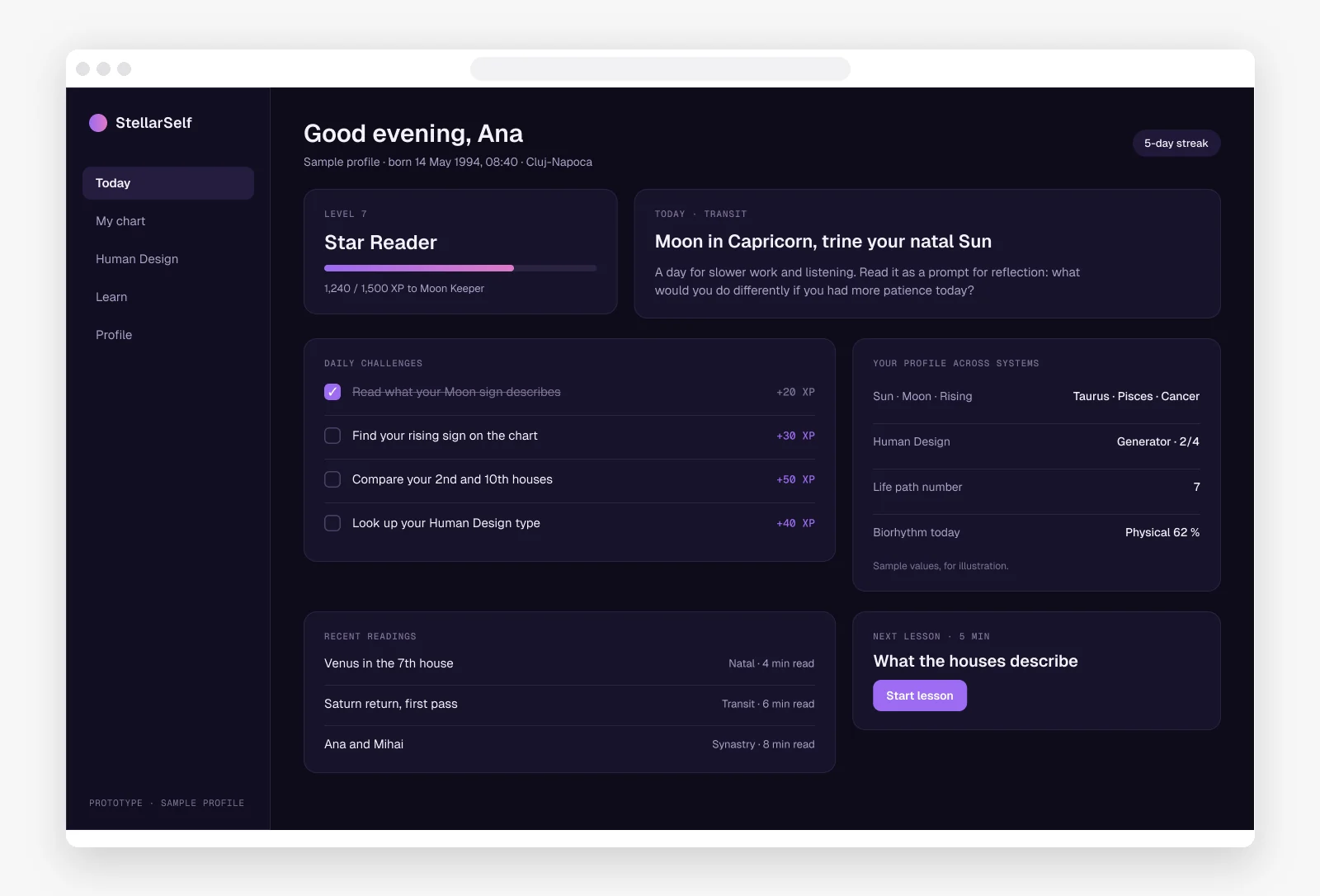
Today: level, transit, challenges. Sample profile. -
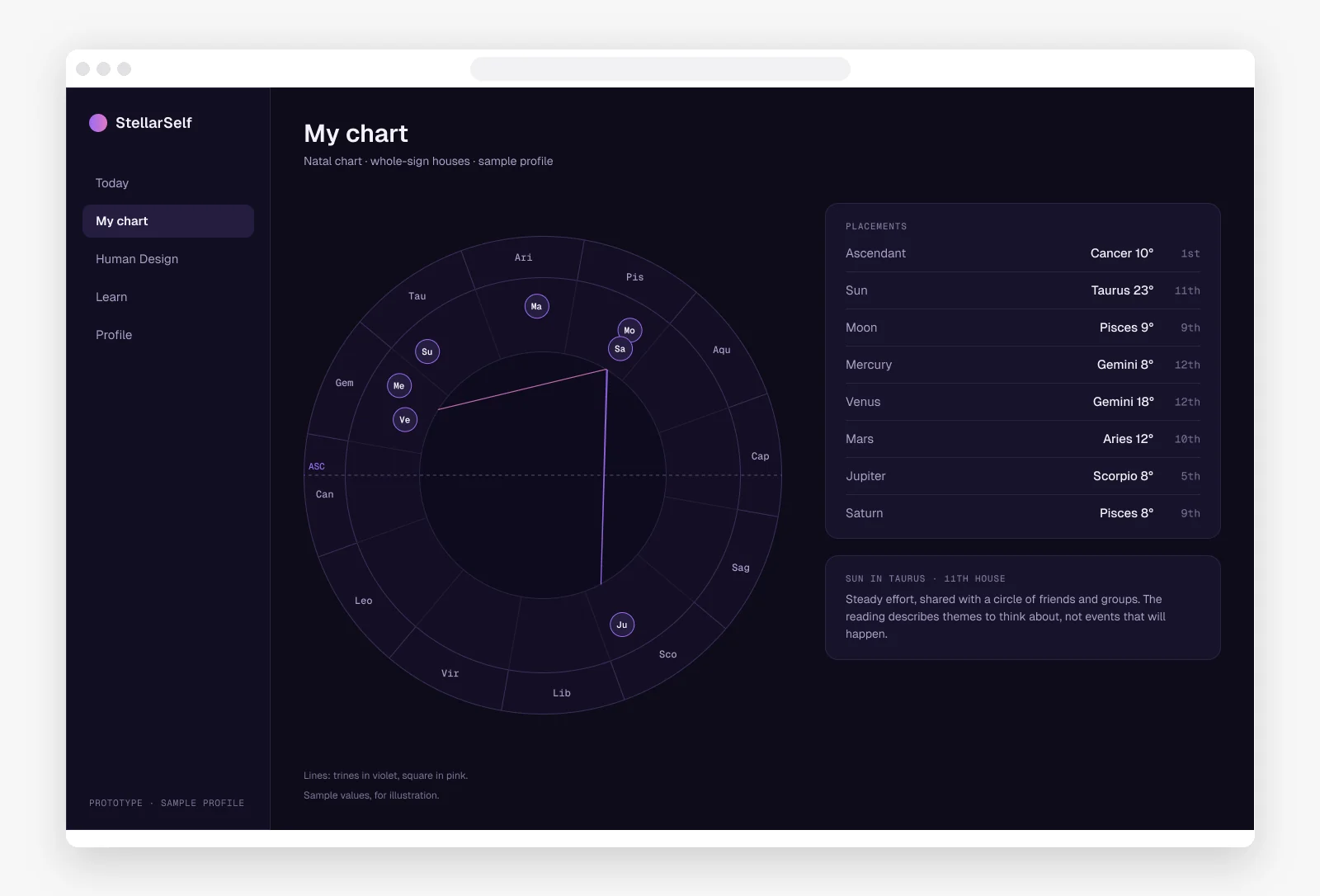
My chart: wheel, placements and a reading. Sample values.
Screens · Mobile
Redesign-
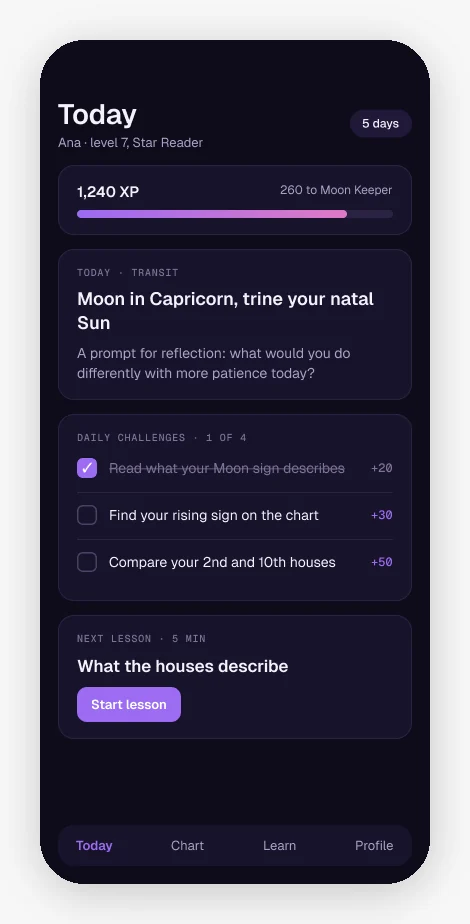
Today on a phone, redesign.
03
Where it stands
-
230
commits between July and December 2025
-
7
systems in one profile
-
14
services in the Docker deployment
-
35
API routes in the December rewrite
Status, October 2026: archived prototype. It ran on our own server until that server was retired and is not live today. The screens on this page are a redesign with a sample profile; no real user data is shown.
04
What a relaunch would need
New hosting for the calculation services, a human editor to review every interpretation text, and a clear statement in the product that readings are for reflection and entertainment, not advice.
Birth date, time and place are personal data. A relaunch would store them encrypted, let people delete their profile in one step, and keep the AI summary optional.