Case study · IoT + AI concept · Forestry
ForestWatch: a concept for spotting irregular timber transport at the bridges trucks must cross.
A research and system-design concept: weigh heavy trucks as they cross a bridge, read the plate, let on-site AI recognise timber, and send only the doubtful passages to a person for review.
- Client
- Wiserwires R&D
- Service
- IoT · AI · web app
- Timeline
- 2026, concept
- Stack
- Bridge WIM · ANPR · edge AI (YOLO) · Next.js
01
Why we looked at it
Romania holds more of Europe’s remaining old-growth forest than any EU country outside Scandinavia, and illegal logging has been a long-running problem there. In 2016 the country classed illegal logging as a threat to national security [1], and in February 2020 the European Commission opened an infringement procedure over the protection of forests in Natura 2000 sites [2].
Every timber load has to travel with a digital transport notice in SUMAL 2.0, the national traceability system launched in 2021 [3]. Paperwork can be checked; what is hard is noticing, in real time and on remote mountain roads, the truck whose load doesn’t match its paper, or that has none.
Bridges are natural checkpoints: trucks leaving a valley have to cross them, and bridge weigh-in-motion can weigh vehicles at speed with sensors fixed under the deck, without cutting into the road [4]. Public image datasets of logs, such as TimberSeg [5], make it realistic to train a model that recognises timber cargo.
Sources
- OCCRP — Romania: illegal logging declared a ‘threat to national security’ (2016)
- ClientEarth — EU announces legal action against Romania for illegal logging (February 2020)
- EIA — Romania’s new timber traceability system, SUMAL 2.0 (February 2021)
- Wikipedia — Weigh in motion (bridge weigh-in-motion)
- Fortin et al. — Instance segmentation for autonomous log grasping, TimberSeg 1.0 (arXiv, 2022)
02
What we designed
-
Sensing at the bridge
Strain sensors under the deck weigh each axle as the truck crosses. Plate-reading cameras cover both directions and an overhead camera sees the load bed, with infrared for night. Solar panels and a battery let a site run off-grid.
-
Decisions on the roadside computer
An edge AI module checks whether the cargo is timber and roughly how much, matches the plate to the weighing and runs the rules. Only flagged passages leave the site, with their evidence frames, which keeps data and bandwidth to what is needed.
-
Rules a person can follow
No transport notice found; weight far from the declared volume; repeated trips within 24 hours; night runs. Checking notices depends on an official interface to the national register, which the concept treats as a prerequisite, not a given.
-
An operator console and a field alert
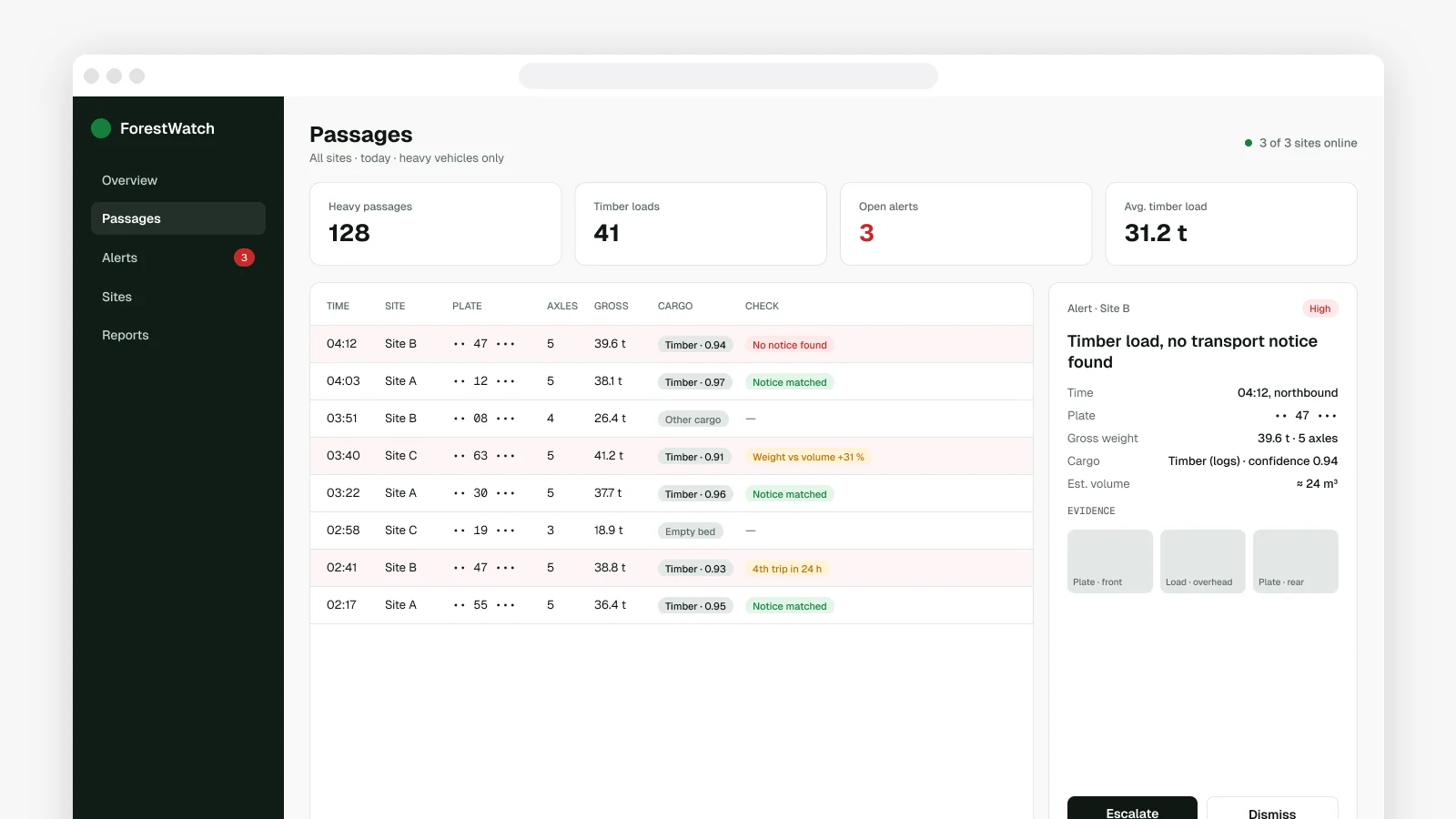
ConceptLive passages and open alerts per site, an evidence view with weight, plate and frames, and a mobile alert for officers in the field. A person decides; nothing is sent to authorities automatically.
Screens · Architecture
-
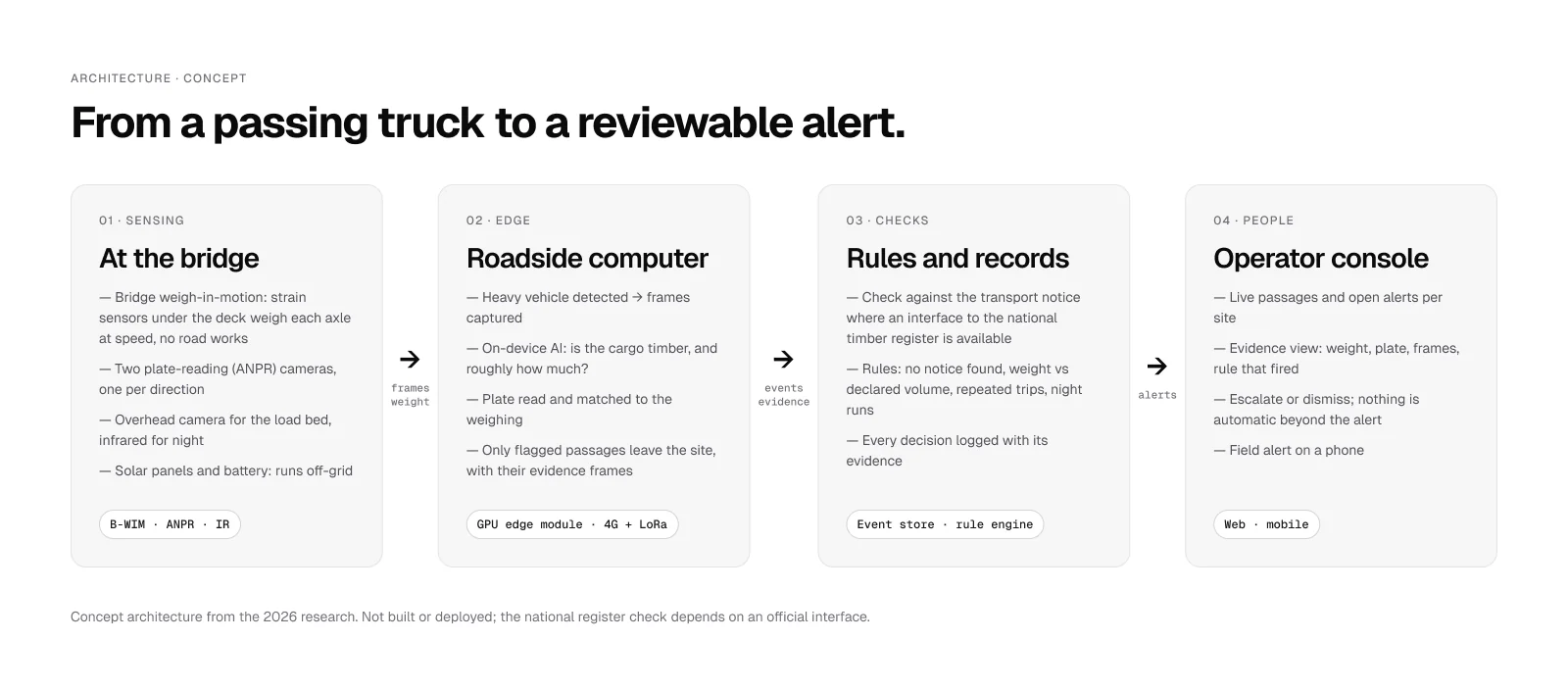
Four layers, from the sensors under the bridge to the person who reviews the alert.
Screens · Concept screens
Concept-
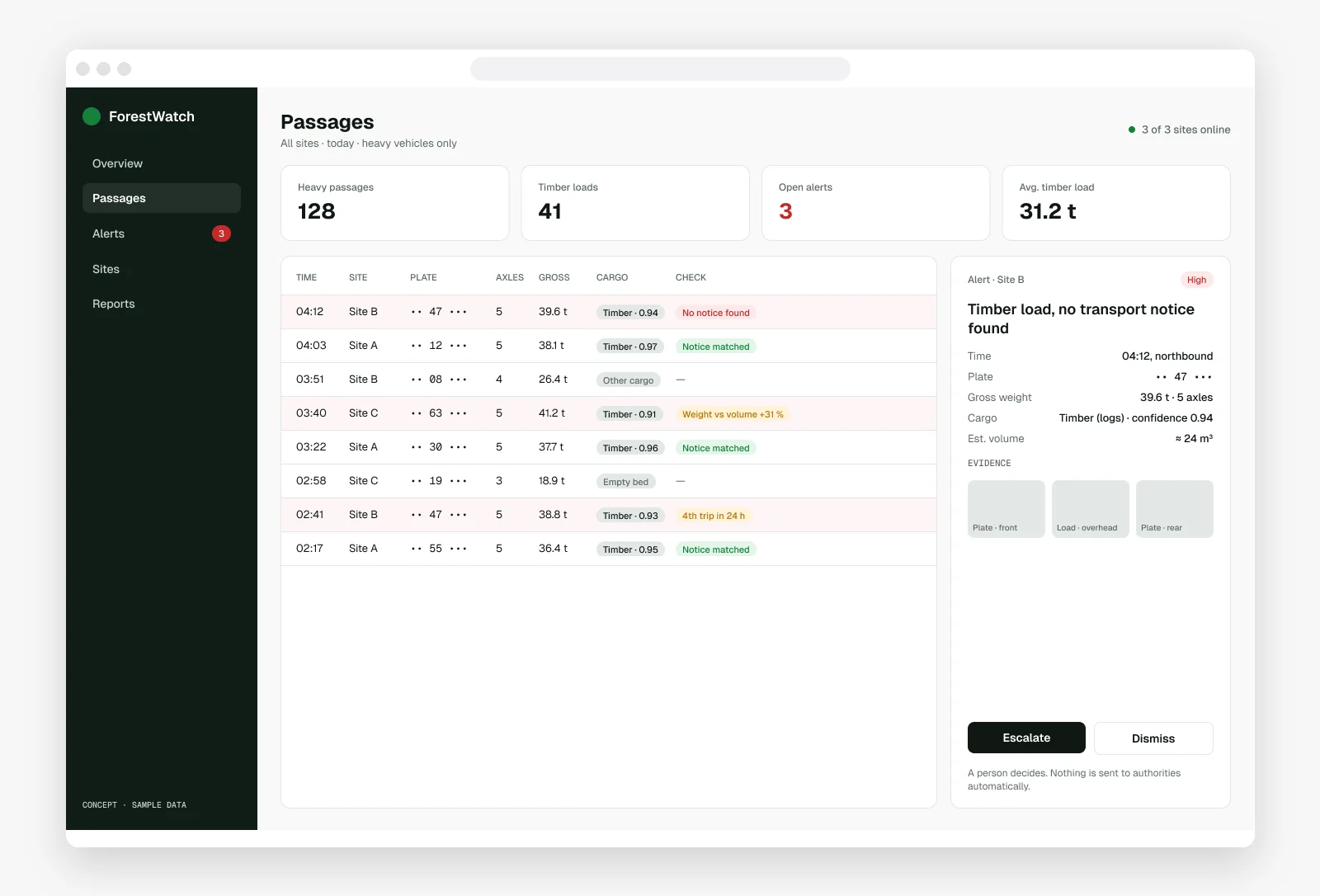
Operator console, sample data. -
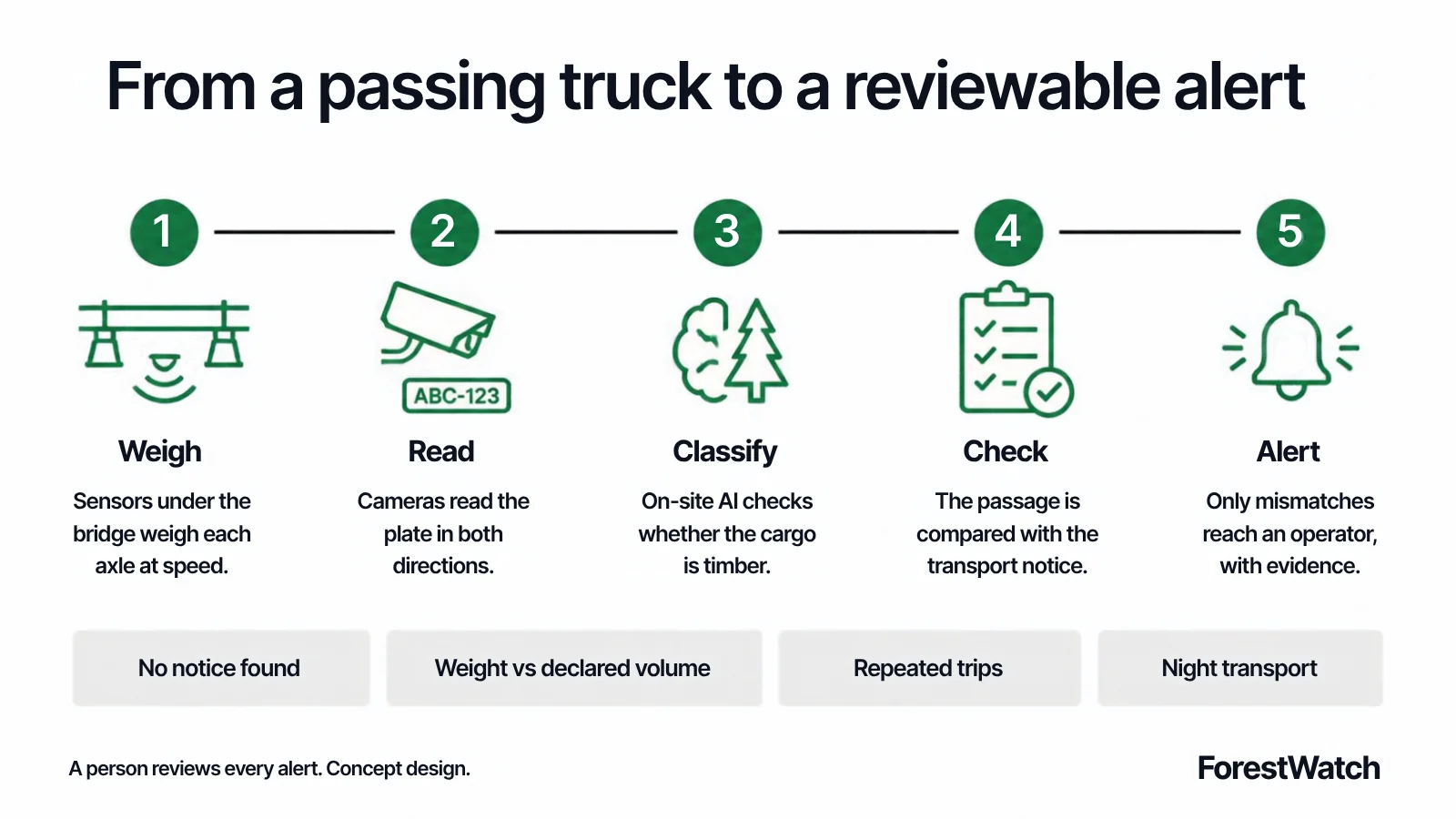
From a passing truck to a reviewable alert.
Screens · Field alert
Concept-
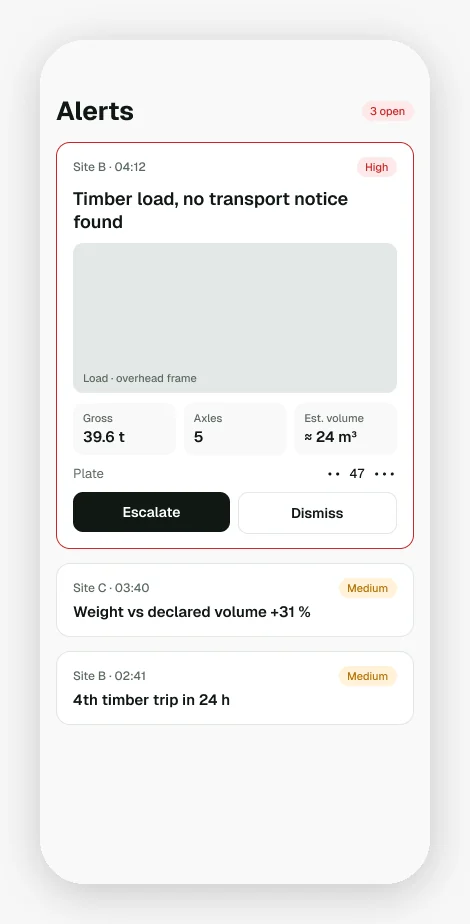
Field alert concept, not built.
03
Where it stands
-
4
layers designed: sensing, edge, checks, people
-
4
alert rules, each tied to its evidence
-
2
deployment options compared: bridge weighing and road cameras
-
3
concept screens: console, field alert, flow
Status, October 2026: research and system design only. There is no code, hardware or deployment; all screens are design concepts with sample data, and no sites or partners are named.
04
What a pilot would need
A partner able to authorise a bridge site, access to an official interface for transport notices, and a set of labelled images of local timber trucks to train and test the model.
Plates are personal data. A real deployment would keep only flagged passages, limit who can see them and delete the rest on a short schedule.